
The intelligent Operating Fabric for streaming data
Build, govern and operate Kafka apps - with engineers and AI agents under one platform. Across any Kafka.
The shift from human scale to agent scale
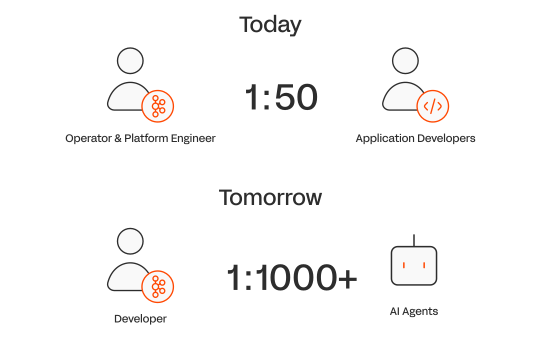
The access model built for 50 engineers doesn't work for 1000 agents
Traditional Apache Kafka tooling was built for human operators - at most a few dozen.
Successful modernization of systems to real-time now requires bringing AI Agents into the development and operations workflows.
This ratio flips: a single platform engineer now supervises hundreds of engineers and agents that build, deploy, and operate Kafka applications.
Manual access control, ad-hoc audit logs, and human-paced change management weren't designed for that velocity. Lenses was.
Let developers and agents do their thing. Know exactly what they did.
The same governance, observability and processing power - whether the request comes from a person at a terminal or an agent in an IDE.
Govern
Unify data access and permissions globally
Discover
Find and explore streaming data across domains, with SQL
Process
Prepare data for easier consumption with SQL
Integrate
Deploy data streams independently, anywhere your business needs


Developers
Platform admins
Technology leaders

Lenses has been invaluable for our engineering productivity. Lenses for multi-Kafka allows us to further scale our streaming initiatives.

Whether it's migration, security, or a new functionality that can improve our business, Lenses.io and AWS are always there for us. They're two very good partners.

With the Lenses K2K replicator, our team is equipped with instant data distribution.
Bring your own Kafka
Lenses connects to any Kafka - Confluent Platform, Confluent Cloud, Amazon MSK, Redpanda, or self-managed Apache Kafka. Deploy in your cloud, on-prem, or across a hybrid environment.
Engineers, AI agents, and analysts all onboard to one governed self-service layer. One access model. One audit trail. A single place to understand what's happening across your entire streaming estate.
What makes Lenses unique
Unified experience

For engineers & agents across any Kafka & vendor
Enterprise-grade security

Scaling for AI Agents to build & operate apps
Sovereign

Avoids vendor lock-in from infrastructure provider
You choose the way you work with Lenses
The beautifully visual experience
The classic, responsive UI engineers love - now upgraded with a completely revamped, IDE-like SQL Studio.
Lenses expertise in your code editor
Query Kafka schemas, check consumer lag, and deploy streams without ever context-switching out of your IDE.
Kafka context for Claude or Cursor
Empower agents with context of your real-time data and infrastructure using enterprise-grade governance and OAuth 2.1.
Automation with your CI/CD
Standardize your Kafka and streaming data operations with your existing developer tools.

Try Lenses for yourself

20 minute demo

- Get a guided tour of Lenses
- Receive a trial key to install on your clusters
- Perfect for production and large-scale streaming deployments